Featured Post

The link to Americ's SoundCloud (It's wonderful to hear his voice)

https://soundcloud.com/americ

Wednesday, October 25, 2006

Thought vs. action

"Better to act, than to wander around in dreams"
--from the Ramayana (ancient Hindu epic)

Over twenty years ago, I went down to Silicon Valley to present a consulting project that blended philosophy with business. My partner in this venture was a well-known existential philosopher who had resigned his bookish university job to become a management consultant to large multinational corporations.

We sought to transform short-sighted, profit-focused, C.Y.A. ("Cover Your Ass") corporate creatures into philosopher-executives. They would be modern-day versions of Plato's philosopher-king, embodying both leadership and wisdom.

My partner, much older and wiser than myself, put it to one of these anxious managers: "The difference between thought and action is that to think involves no risk; but every time you act, you risk death!"

He did not mean actual physical death, but the little death our egos suffer. To act is to risk failure; ideas that look so good to the mind don't always work out.

The corporate group was very impressed with our presentation. But in the end they did not buy the program. No one in the department dared to act. All our observations about their state of inaction didn't help. As I walked around the office I was amazed that anything ever got done. They looked like a bunch of bees buzzing around each other's cubicles. The place was filled with pleasant people, but deep down they were all afraid to do a wrong thing. No one wanted to look bad.

Peter Koestenbaum once told me, "Anxiety is what you feel between the thought and the action". Imagine how you feel on the edge of a pool of cold water, just before you jump in. You know you'll feel good after you do it. But the water's cold!

Life is filled with such situations. You have a good idea. You want to tell the boss. You know she might think it's stupid. You sit on the fence between thought and action. More often than not, you do nothing. You let the moment pass.

Companies are filled with people unable to act. There are worlds of fearful people out there. The decline of American productivity, I suspect, has a lot to do with this. A huge problem in government, too, which is why nothing gets done there either.

Some folks confuse talking with action. But talking is just dreaming out loud. I used to lead meetings. We would discuss ending the meeting, yet it would drag on. One day I discovered that all I had to do to end a meeting was to stand up! Talk may be cheap, but it can last forever.

The philosopher Martin Heidegger noted (Being and Time) that death provides us with the best opportunity to contact our utmost being. We immediately know ourselves when we're faced with death. Likewise, we may accomplish remarkable things in our dreams and fantasies. But in the light of day, faced with reality, we see who we really are.

If we live each day as if it is our last, we will not hesitate to act.

Eminem said it like this (Lose Yourself):

Look! If you had one shot, one opportunity,
to seize everything you ever wanted, in one moment -
would you capture it, or just let it slip?


Monday, September 11, 2006

Coming home


I grew up in two worlds: Portuguese and American. I never felt completely at home in either world. I did not speak a single word of English until first grade. At home I spoke only Portuguese, and at school I heard only English. The feeling and thought patterns of these two worlds became locked up in separate language systems.

I felt uncomfortable whenever my parents came to school. I did not want my friends to see me with these people who spoke very little English. If one of my American friends came over to spend time at my home, my mother became very uncomfortable. Before long my friends stopped coming over, and I wasn't allowed to visit them. School became the middle ground and battleground between these two worlds.

We all live in many worlds. Some of us may be attracted to the transcendental, but at the same time want to live a worldly life. Many of us want to be free of possessions, but still have a beautiful car or home. Most everyone feels at some time that the "grass in greener on the other side."

The question "where is home?" is deeply important. I've always had two "homes". After spending time in either home, I would get an urge to go to the other home. At home with my parents, I wanted to be in school. At home in school, I wanted to be with my parents. That was the restless quality of my growing up in two different worlds.

At the moment of birth, separation from our mother's womb, we lose the most secure home of all. From then on is pure change. All humans eventually come home -- by physical death or by becoming enlightened or fulfilled.

Where is home? Being truly home is being centered in your real self - an inner center of gravity. Home is our own deepest center. If you don't find home within yourself, you'll keep searching for it outside yourself. Home is where we rest.

Home is where the heart is.

Wednesday, July 19, 2006

Who is the peacemaker?


When there's lots of talk of war in the news, it's a very natural response to wonder, is peace possible, and who is the peacemaker? I tend to react instinctively, and say that peace has to come from within, that one must learn how to be peaceful from a special place inside. But it's not that simple. Even as individuals we feel anger, and that anger festers inside, and somehow has to work its way through us, or outside us, it may have to create depression, or we may have to get angry and express it. Then it's over, like a storm it's over. I suspect that wars are like that. Some kind of emotional/spiritual toxicity develops, and there may be no way to avoid releasing it, which appears totally irrational and crazy while it's happening.

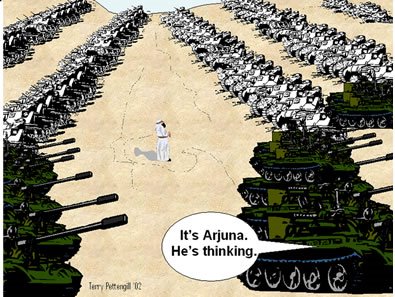
So how can there be peace? I don't have an answer. If I look to ancient teachings, like the Bhagavad Gita, there is a war between two groups, two families that know each other well. Arjuna and Krishna are in the field of war, and Arjuna says to Krishna, "Take me to the middle between the two armies." And for a moment, time stands still, and they contemplate the 'reality beyond the relative reality' of everyday life with all its killing. And Krishna says to Arjuna, "You know these people cannot really be killed. They always have been, and always will be." Yet Krishna also says to Arjuna, "You must fight, because that is your destiny."

It may be our destiny to fight and to kill, who knows? We are only human, after all. If even the gods must fight, perhaps we must too. Yet if there is ever peace, then that peace must have been our destiny too. Ultimately we may have no choice, but we have the very real illusion of choice. We can choose war, and we can choose peace. Who is the peacemaker? He or she who makes the peace.

Monday, July 03, 2006

300 year vision

I’ve challenged students, friends and business associates to imagine a future 300 years from today. A simplistic short-term bottom-line focus is leading to a global “flat-line”! Let’s plan for life on earth 300 years from now, or even a 1000 years from now. We must become “Y3K” compliant! By way of good planning, execution, and wisdom we may get to the year 3000 with lives worth living. Seventh Generation quotes the Great Law of the Iroquois Confederacy on it’s recycled paper product packages:

"In our every deliberation we must consider the impact of our decisions on the next seven generations."

I have grandchildren, and am young enough to possibly see great-grandchildren. For me, leaping to 300 years or seven generations is getting easy. Today's "little" actions impact our children's children. Our immense intellectual powers look into the edges of space-time, and with powerful computers model the trends of global warming. We cannot play deaf and dumb without seriously denying responsibility.

Environmental changes are slow. Mothership Earth is going down, but most of us don’t see or act upon it yet. The way to "humanely" kill a calf is by placing it in a vat of water and slowly turning up the heat. Eventually, the water gets hot enough to kill the calf without the calf noticing how hot the water really is. This will be humanity's fate on earth.

There are thousands of little, personal decisions made everyday that determine the next 300 years. Drive the car? How far? What kind of car? What is the fuel efficiency? Can we walk when possible. Do the office email at home rather than commuting to the office. What kind of paper products will we buy? How many children shall we have? How big a house? A second house? Do we need to fly somewhere for a vacation? Are there ways to feel wealthy without consuming mother earth?

The developed world is encased in technology. The solution is now more cultural than technological. Let’s breath free again. It's time for a great re-tooling, re-valuing of how we live, think, and exchange goods and services; time for a true revitalization of civilization along more human and earth friendly lines.

Tuesday, June 13, 2006

De-materialization of money

For years, I carried little pieces of gold, jade and silver in my pocket. I got the habit from my friend Glenn, who enjoyed buying small amounts of gold and silver along with hunting for jade at Big Sur beach in California.

Jade, silver and gold make excellent money tokens. The de-materialization of money started with paper money. Originally, paper money was "backed" by gold, silver or other tangible items. Later, we removed the "backing" or base of the money. Effectively, debasing the money.

Electronic computing turned money into intangible data configurations stored in computers. Actually, "money" is even more intangible than the computer's memory and electrons. It is the meaning that we give to these configurations that define money. Money has absolutely no physical basis at all, not even the electrons. It's all mental.

Money is a matter of conventions of social trust between us, banks, and governments. Inflation, deflation, monetary collapses are proofs of the conventional status of money. That should make us free of the spell of money, but it does not; for we depend on social conventions of trade and exchange for survival in our age of specialization.

Tuesday, May 23, 2006

Seung Wook Kim: virtual reality and phenomenology

Seung Wook Kim is one of my Graduate Student Instructors at IDS110, Introduction to Computers. In the Spring 2006 semester he lectured on "Virtual Reality and Phenomenology". With so many of us spending massive amounts of time in cyberspace, this is a vital subject.
Podcast of "Virtual Reality and Phenomenology"