Featured Post

The link to Americ's SoundCloud (It's wonderful to hear his voice)

https://soundcloud.com/americ

Friday, September 18, 2026

Understanding the Possibility

More than this, I cannot say today! 
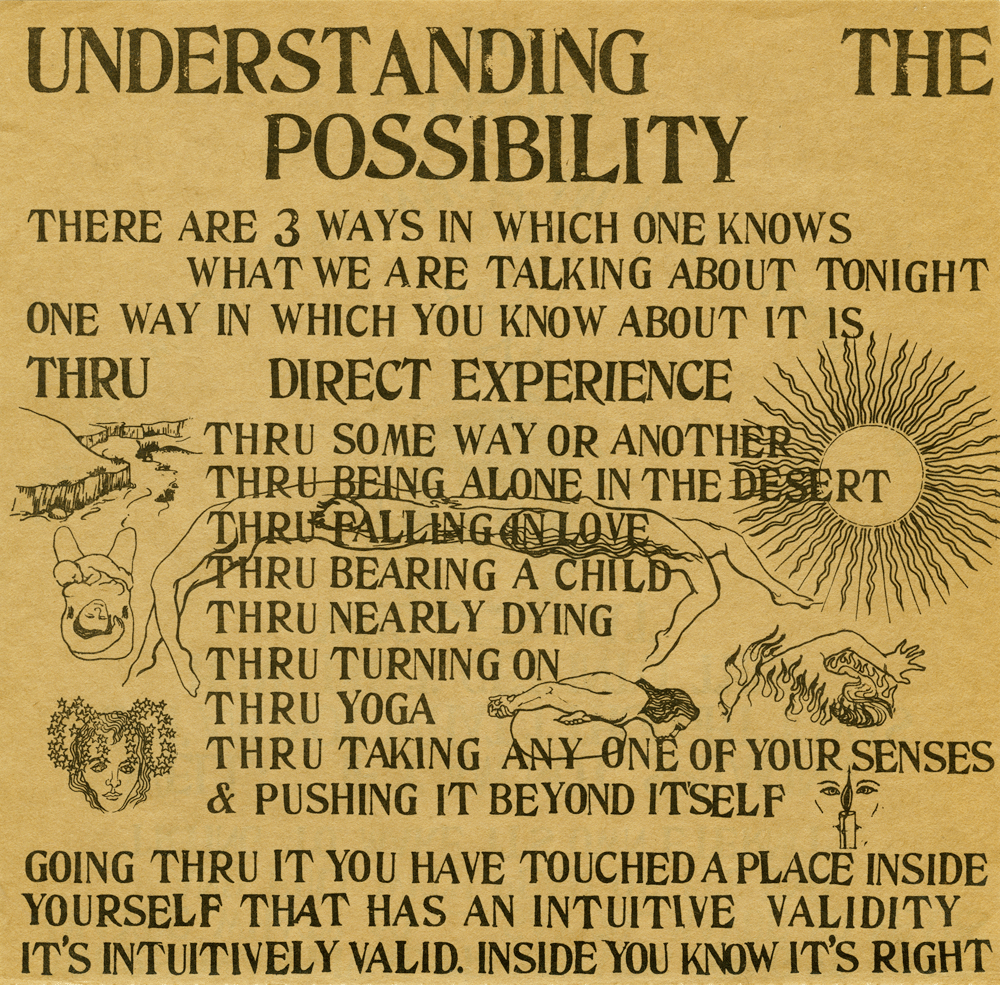
from Ram Dass

Between birth and death

Suzuki, in Zen Mind, Beginner's Mind, gives a wonderful metaphor for life, birth, and death – a waterfall. If you think of a river flowing downstream, it is all one river. When the river reaches the edge of a waterfall, it breaks up into billions of drops of water. The individual life is like one of those drops of water. Our friends and family are those drops of water around us, that fall with us. We see ourselves as separate, individual. Then, at the bottom of the waterfall, we become the river again.

Life happens between the top and the bottom of the waterfall. Birth is that moment we become separate, the span of a life is the time we fall as individual drops of water, death is the moment we merge back together. Unity before birth, separation during life, unity again at death.


* "Waterfall" (2003) - original audio version of this post. Another version published in my book, Meditation: Awaking Up to Life, Cognella Academic Publishing, 2010.


Deep Nonviolence

Nonviolence is not-harming; it's what we don't do, not what we do. There's vast spaciousness in allowing things to be what they are short of violence. Nonviolence reminds me of the Taoist idea of "doing not doing"; by not-harming, by being nonviolent, we are going with the flow of life. The term "peace", however, is more limiting. It implies specific institutions and actions such as talk of "peace keeping armies". Nonviolence is one of the most ancient of great ideas: "ahimsa" - the Sanskrit word meaning "not harming" in the old Jain religion of India and later in the Vedic, Hindu, and Buddhist scriptures. Furthermore, we find strong suggestions of nonviolence in the ancient Jewish and Christian scriptures. Indeed, the earliest Christians would not fight in wars. In the mid twentieth century, "nonviolence" was a political strategy. We see scenes of mass demonstrations for Indian independence from the British, U.S. black peoples' civil rights protests in the deep South, and grape boycotts to secure rights of migrant farm works. While teaching nonviolence at the University of California, Berkeley, I became clear that nonviolence as protest is too narrow. Now, I sometimes use the term "deep nonviolence" to point to nonviolence at the root level -- where constructive actions naturally arise. This especially addresses the deep crisis between the whole of humanity and all other life on earth. The violence of humans upon the earth and it's living forms is now apparent. Deep nonviolence looks upon all our actions that may, can, and do harm life on earth. By working toward eliminating such actions (at all levels), we allow the earth to heal, to return to it's natural state of harmony and health; just as we can allow our bodies to heal of themselves by not harming them with drugs. Nature wants to be healthly; people want to be at peace. Remove the harming, and the rest takes care of itself.