Featured Post

The link to Americ's SoundCloud (It's wonderful to hear his voice)

https://soundcloud.com/americ

Thursday, December 06, 2007

Mitt Romey on respect for many religions

NOTE: I am not endorsing Mitt Romey for President. But, am impressed with his wording on the issue of religion.

Mitt Romey's December 6, 2007, speech on religion contains the following, beautiful passage. Worth quoting:

"I believe that every faith I have encountered draws its adherents closer to God. And in every faith I have come to know, there are features I wish were in my own: I love the profound ceremony of the Catholic Mass, the approachability of God in the prayers of the Evangelicals, the tenderness of spirit among the Pentecostals, the confident independence of the Lutherans, the ancient traditions of the Jews, unchanged through the ages, and the commitment to frequent prayer of the Muslims. As I travel across the country and see our towns and cities, I am always moved by the many houses of worship with their steeples, all pointing to heaven, reminding us of the source of life's blessings.

Friday, June 22, 2007

Remember, remember!

The following verse, constitutes a Hindu prayer uttered at the moment of death and often said in funeral rites. It's a good prayer for living well.

Absolute and relative – he who knows these two together, through the relative leaves death behind and through the Absolute gains immortality.

The threshold of Reality is veiled by golden light.
Reveal It, O Lord, for the guiding purpose of my life is to know the truth.

O Lord of light, the knowing one, the golden guardian, giver of life to all, spread apart your rays, gather up your brilliance, so I may perceive your finest and most splendorous nature, the cosmic spirit that lies at your heart.

For I myself am that!

Let my breath merge with the cosmic breath; may my body be as dust.

Remember, O mind, remember what has been done.
Yes, remember, O mind, remember what has been done!

O Agni, show us the right path, lead us to eternal freedom, You who know everything.
May we not be diverted from our goal, for with all devotion we submit ourselves to You.

from
"Isha Upanishad"
Translated by Alistair Shearer and Peter Russell

Monday, May 21, 2007

Maranda and Steve - on the meaning of life


I interviewed a father (Steve) in his forties and his daughter (Maranda) who is 12 and a half. The audio includes both interviews. We can learn much from this father-daughter team.


LISTEN TO "Maranda & Steve on Meaning of Life" (4.18 mb; time 04:34)

Audio production by Lynette Webb.
Image from iVillage - Family Photo Gallery.

Saturday, April 28, 2007

"America" means "rich in love"


A friend of mine once sent me a postcard suggesting the real meaning of my name (actually spelled "Americo"). Having grown up as a Portuguese immigrant in Southern California, I had insecurity about my name. How could I live up to the country that my father named me after? My friend explained it this way:

Americo = Amo, ame (for "love") + rico (for "rich" as in Porto Rico, "rich port"). "Americo" means "rich in love". (In Italian it looks like "Amare ricco" and in Portuguese it's "Amor rico". Change the "o" to an "a" to go to the female form which "America" looks like.)

Perhaps, the real meaning of "America" is: the United State of "Rich in Love". These days, it doesn't look that way, unless making war instead of love is our way. My faith is that when this country gets past living in fear, it will rediscover its roots in love. There is much in a name.
Image from Riding Holidays.

Tuesday, April 10, 2007

Hubert Dreyfus on "What's the meaning of life?"

Hubert Dreyfus Interview: On the Meaning Of Life by americ

In March 2007, I paid a visit to Professor Hubert Dreyfus at his office in the University of California, Berkeley. He takes the question of meaning of life seriously. You will find his remarks provocative. Wikipedia reports that "Professor Hubert Dreyfus is a contemporary American philosopher. He is considered one the world's leading analysts of postmodern philosophy from Edmund Husserl to Michel Foucault, Maurice Merleau-Ponty, and especially Martin Heidegger.."
Audio production by Lynette Webb.

Saturday, March 31, 2007

The Sacred Mirrors of Alex Gray

For a great web adventure into the mystical realm go to Alex Gray's website, then select "Paintings" (left panel), then select SACRED MIRRORS, and if you can, select LAUNCH FLASH NAVIGATOR. It's a wonderful visual journey.

This journey suggested to me by Fred Brown, Universal Yoga.

Wednesday, March 21, 2007

Cultivating Spiritual Wellness


On March 10th, 2007, I delivered a talk/dialogue "Cultivating Spiritual Wellness" at Elephant Pharm, Berkeley, California.

LISTEN TO "Part 1, Cultivating Spiritual Wellness" (6.10 mb; time 26:39)

Audio production by Lynette Webb.Image from University of Minnesota Department of Recreational Sports.

Friday, March 09, 2007

Still point of the turning world


In March 2007, I delivered the following lecture in my "Time, Money and Love in the Age of Technology" seminar at University of California, Berkeley. It is a commentary inspired by T. S. Elliot's poetry.

LISTEN TO "Still point of the turning world" (5.50 mb; time 24:02)

Saturday, March 03, 2007

What's the meaning of life? (Part 1)


I was having coffee with my friend Glenn at Peet's on Lakeshore in Oakland. A Catholic priest in a long black coat walked in. Glenn said, "maybe we can ask him what the meaning of life is?" I thought about that for a while; and, realized it would be fun to go around and ask friends , co-workers and others for their thoughts on the meaning of life.

Here's the first segment of answers to the question "What is the meaning of life?" Respondents range in ages from 11 to over 70 years. Voices, in order of interview, are Jacob Jr., Glenn, Daniel, and Becky. I'll let you figure out from the sound of their voices how old they are. Enjoy.

LISTEN TO "Meaning of Life - Part 1" (784 kb; time 03:19)

Audio production by Lynette Webb.
Image from Eric Weisstein's Home Page.

Sunday, February 11, 2007

The art of coffee drinking


The art of coffee drinking is, along with tea drinking, one of the crowns of "the art of living." It can be practiced everyday, under different conditions.

I've gone to coffee houses for being alone -- especially to get away from the people at home, so I can write, think, speculate, ruminate, or do business. Then again, I go to coffee houses to be with people in a light way.

One of my very best friends told me that we need only plan having a cup of coffee each day! The rest takes care of itself. For us, this became a spiritual practice much like the Japanese tea ceremony. Of course, many things may happen in one day. But the art of coffee drinking is in the ease, the gentleness of the act. The simplicity of the situation. Life is good when kept down, for a moment, to a single point.

Sometimes, we would go to a place, like The Coffee Mill in Oakland, and talk about books whether, Martin Hiedegger's Being and Time or A Course in Miracles, and take periodic "mind breaks" that we called "twelve seconds." These mind breaks consisted in looking at a spot on the wall or remembering just one word for twelve or more seconds, until the mind experienced a moment of pure stillness.

That is the essence of the art of coffee drinking: to bring the mind to an active stillness. To be relaxed, yet wide awake. We naturally get this state when we drink good coffee in a good coffee house or in our favorite spot at home. Most of my best writing happens in coffee houses such as The Coffee Mill in Oakland or The Cafe Mediterranean on Berkeley's Telegraph Avenue. For me, going to the same places over and over again has a way of stimulating the writing process. But I write just a little bit each time. I don't write continuously, for that would turn the coffee house into an office, a place of work.

The power of simplicity can be seen in almost all aspects of life. The judo master flips the opponent with a thought. Remember when Ronald Reagan and Mikhail Gorbachev shook hands in front of a fireplace -- and the world felt like it was moving closer to peace between the superpowers.

Going to a coffee house and drinking that cup has become like a church mass for some of us. It is part of the ultimate order of life itself. A sign that things are working well enough for at least a few moments.

When the mind is alert and at ease, miracles begin to happen. Clear conversation between people becomes possible. If you go to the same coffee house regularly and often, you begin to know an extended community of fellow lovers of life. The alienation of modern human existence is reduced.

A cup of gourmet coffee is a joy to the palate, just like fine wine. The flavor is rich, but not bitter. The acidity is low and not a disturbance to the stomach. Coffee should be taken in moderation -- it is a drug not a food. Treat it with respect. Two strong cups a day can be more than enough. Better yet, only one cup. We should get high on life itself -- not caffeine, alcohol, or whatever.

We get the most from coffee when we practice the high art of coffee drinking. Drink it slowly. Don't gulp it down. Do not ruin the experience with "to go" coffee. Sit down. Look out upon the passing world and the people all around. Know that there is time.

My cup is now empty. My writing pad is filled with these notes. Time to go to the word processor.

Monday, January 01, 2007

Root of the Golden Rules


All the world's major religions include some statement of what is called The Golden Rule in their primary ethical consideration. To do to others what we would have others do to us. Let’s go deeper and ask: “From where does the golden rule come?” I claim that it comes from a common root experience had all over the world in all ages. This is the experience of cosmic consciousness, which occurs in many different ways and circumstances.

LISTEN TO "Root of the Golden Rules" (duration 0:03:26; 1.57 MB; 64 kbps)

Sunday, December 24, 2006

"Make Love, Not War" - could this be true?


One day during the Iraqi war, I started thinking about the old idea "make love, not war". Could it be true that if our leaders spent more time making love, they would make less war? The media certainly has an easier time displaying violence and violent sex, rather than affection and loving sex.

Peter Good, author of The Monkey Experiment, called my attention to the cross-cultural studies of James Prescott -- which indicate that physical affection during infancy and adolescence reduces violence. So, "make love, not war" may even have a scientific basis.

We have yet to learn how to be for life rather than against life. Perhaps our leaders would do well to learn how to "make love, not war" and thereby set an example for a peaceful society. The following passage from Prescott is suggestive of a new way of looking at war and peace:

"The strength of the two-stage deprivation theory of violence is most vividly illustrated when we contrast the societies showing high rates of physical affection during infancy and adolescence against those societies which are consistently low in physical affection for both developmental periods. The statistics associated with this relationship are extraordinary: The percent likelihood of a society being physically violent if it is physically affectionate toward its infants and tolerant of premarital sexual behavior is 2 percent (48/49). The probability of this relationship occurring by chance is 125,000 to one. I am not aware of any other developmental variable that has such a high degree of predictive validity. Thus, we seem to have a firmly based principle: Physically affectionate human societies are highly unlikely to be physically violent."

from James W. Prescott, Ph.D.: Body Pleasure and The Origins of Violence. First published in The Futurist, April 1975, this version from The Bulletin of The Atomic Scientists, November 1975, pp. 10-20 (last modified 2002/05/11).

Image from McMaster University - U. S. Sixties History.

Saturday, December 23, 2006

What do we turn to? (part 2)


When Diane Shavelson heard my comments in Part 1 of "What do we turn to?" she reported changes within her lifetime in people's relationships to each other and media devices. Instead of seeking companionship, one turns on the TV or radio to fill up the room with voices and sound.

LISTEN TO "What do we turn to? (part 2)" (1677 kb; time 3:34)

Thumbnail image from Corbis.com image library.

Monday, December 18, 2006

What do we turn to?


How do we spend our days and nights? With people? With devices and media? Modern life has a new kind of turning to that's different from older societies. Now we turn more often to devices rather than other people. I've seen whole families sitting together at tables, each one with their smart phone communicating with others elsewhere (not those in front of them). Sad story it is.*


The Way We Live by Patricia Yollin, Staff Writer, San Francisco Chronicle, December 15th, 2006.

Monday, December 04, 2006

God in the Empty Places

I liked it when you almost said communicating with yourself rather than God. That's a lot of what God is for me. Maybe it's a personal god, maybe a guide, but when I speak to God I'm most often speaking to a part of myself. I'm not godlike, but that part of me is. In touch with everything, guiding my actions (I hope), telling me what I need to know. Maybe that's how God keeps us straight, or tries to—by living inside us, like a branch office in every city. A part of our being in touch with every other being, and there for us when we need it.

- Peter Good

LISTEN TO "God in the Empty Places" (time 3:23)

Wednesday, October 25, 2006

Thought vs. action

"Better to act, than to wander around in dreams"
--from the Ramayana (ancient Hindu epic)

Over twenty years ago, I went down to Silicon Valley to present a consulting project that blended philosophy with business. My partner in this venture was a well-known existential philosopher who had resigned his bookish university job to become a management consultant to large multinational corporations.

We sought to transform short-sighted, profit-focused, C.Y.A. ("Cover Your Ass") corporate creatures into philosopher-executives. They would be modern-day versions of Plato's philosopher-king, embodying both leadership and wisdom.

My partner, much older and wiser than myself, put it to one of these anxious managers: "The difference between thought and action is that to think involves no risk; but every time you act, you risk death!"

He did not mean actual physical death, but the little death our egos suffer. To act is to risk failure; ideas that look so good to the mind don't always work out.

The corporate group was very impressed with our presentation. But in the end they did not buy the program. No one in the department dared to act. All our observations about their state of inaction didn't help. As I walked around the office I was amazed that anything ever got done. They looked like a bunch of bees buzzing around each other's cubicles. The place was filled with pleasant people, but deep down they were all afraid to do a wrong thing. No one wanted to look bad.

Peter Koestenbaum once told me, "Anxiety is what you feel between the thought and the action". Imagine how you feel on the edge of a pool of cold water, just before you jump in. You know you'll feel good after you do it. But the water's cold!

Life is filled with such situations. You have a good idea. You want to tell the boss. You know she might think it's stupid. You sit on the fence between thought and action. More often than not, you do nothing. You let the moment pass.

Companies are filled with people unable to act. There are worlds of fearful people out there. The decline of American productivity, I suspect, has a lot to do with this. A huge problem in government, too, which is why nothing gets done there either.

Some folks confuse talking with action. But talking is just dreaming out loud. I used to lead meetings. We would discuss ending the meeting, yet it would drag on. One day I discovered that all I had to do to end a meeting was to stand up! Talk may be cheap, but it can last forever.

The philosopher Martin Heidegger noted (Being and Time) that death provides us with the best opportunity to contact our utmost being. We immediately know ourselves when we're faced with death. Likewise, we may accomplish remarkable things in our dreams and fantasies. But in the light of day, faced with reality, we see who we really are.

If we live each day as if it is our last, we will not hesitate to act.

Eminem said it like this (Lose Yourself):

Look! If you had one shot, one opportunity,
to seize everything you ever wanted, in one moment -
would you capture it, or just let it slip?


Monday, September 11, 2006

Coming home


I grew up in two worlds: Portuguese and American. I never felt completely at home in either world. I did not speak a single word of English until first grade. At home I spoke only Portuguese, and at school I heard only English. The feeling and thought patterns of these two worlds became locked up in separate language systems.

I felt uncomfortable whenever my parents came to school. I did not want my friends to see me with these people who spoke very little English. If one of my American friends came over to spend time at my home, my mother became very uncomfortable. Before long my friends stopped coming over, and I wasn't allowed to visit them. School became the middle ground and battleground between these two worlds.

We all live in many worlds. Some of us may be attracted to the transcendental, but at the same time want to live a worldly life. Many of us want to be free of possessions, but still have a beautiful car or home. Most everyone feels at some time that the "grass in greener on the other side."

The question "where is home?" is deeply important. I've always had two "homes". After spending time in either home, I would get an urge to go to the other home. At home with my parents, I wanted to be in school. At home in school, I wanted to be with my parents. That was the restless quality of my growing up in two different worlds.

At the moment of birth, separation from our mother's womb, we lose the most secure home of all. From then on is pure change. All humans eventually come home -- by physical death or by becoming enlightened or fulfilled.

Where is home? Being truly home is being centered in your real self - an inner center of gravity. Home is our own deepest center. If you don't find home within yourself, you'll keep searching for it outside yourself. Home is where we rest.

Home is where the heart is.

Wednesday, July 19, 2006

Who is the peacemaker?


When there's lots of talk of war in the news, it's a very natural response to wonder, is peace possible, and who is the peacemaker? I tend to react instinctively, and say that peace has to come from within, that one must learn how to be peaceful from a special place inside. But it's not that simple. Even as individuals we feel anger, and that anger festers inside, and somehow has to work its way through us, or outside us, it may have to create depression, or we may have to get angry and express it. Then it's over, like a storm it's over. I suspect that wars are like that. Some kind of emotional/spiritual toxicity develops, and there may be no way to avoid releasing it, which appears totally irrational and crazy while it's happening.

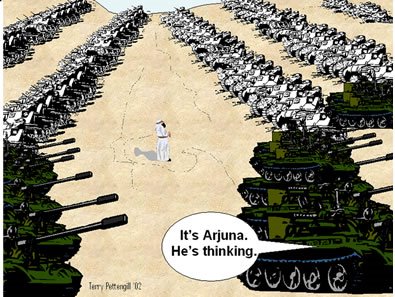
So how can there be peace? I don't have an answer. If I look to ancient teachings, like the Bhagavad Gita, there is a war between two groups, two families that know each other well. Arjuna and Krishna are in the field of war, and Arjuna says to Krishna, "Take me to the middle between the two armies." And for a moment, time stands still, and they contemplate the 'reality beyond the relative reality' of everyday life with all its killing. And Krishna says to Arjuna, "You know these people cannot really be killed. They always have been, and always will be." Yet Krishna also says to Arjuna, "You must fight, because that is your destiny."

It may be our destiny to fight and to kill, who knows? We are only human, after all. If even the gods must fight, perhaps we must too. Yet if there is ever peace, then that peace must have been our destiny too. Ultimately we may have no choice, but we have the very real illusion of choice. We can choose war, and we can choose peace. Who is the peacemaker? He or she who makes the peace.

Monday, July 03, 2006

300 year vision

I’ve challenged students, friends and business associates to imagine a future 300 years from today. A simplistic short-term bottom-line focus is leading to a global “flat-line”! Let’s plan for life on earth 300 years from now, or even a 1000 years from now. We must become “Y3K” compliant! By way of good planning, execution, and wisdom we may get to the year 3000 with lives worth living. Seventh Generation quotes the Great Law of the Iroquois Confederacy on it’s recycled paper product packages:

"In our every deliberation we must consider the impact of our decisions on the next seven generations."

I have grandchildren, and am young enough to possibly see great-grandchildren. For me, leaping to 300 years or seven generations is getting easy. Today's "little" actions impact our children's children. Our immense intellectual powers look into the edges of space-time, and with powerful computers model the trends of global warming. We cannot play deaf and dumb without seriously denying responsibility.

Environmental changes are slow. Mothership Earth is going down, but most of us don’t see or act upon it yet. The way to "humanely" kill a calf is by placing it in a vat of water and slowly turning up the heat. Eventually, the water gets hot enough to kill the calf without the calf noticing how hot the water really is. This will be humanity's fate on earth.

There are thousands of little, personal decisions made everyday that determine the next 300 years. Drive the car? How far? What kind of car? What is the fuel efficiency? Can we walk when possible. Do the office email at home rather than commuting to the office. What kind of paper products will we buy? How many children shall we have? How big a house? A second house? Do we need to fly somewhere for a vacation? Are there ways to feel wealthy without consuming mother earth?

The developed world is encased in technology. The solution is now more cultural than technological. Let’s breath free again. It's time for a great re-tooling, re-valuing of how we live, think, and exchange goods and services; time for a true revitalization of civilization along more human and earth friendly lines.

Tuesday, June 13, 2006

De-materialization of money

For years, I carried little pieces of gold, jade and silver in my pocket. I got the habit from my friend Glenn, who enjoyed buying small amounts of gold and silver along with hunting for jade at Big Sur beach in California.

Jade, silver and gold make excellent money tokens. The de-materialization of money started with paper money. Originally, paper money was "backed" by gold, silver or other tangible items. Later, we removed the "backing" or base of the money. Effectively, debasing the money.

Electronic computing turned money into intangible data configurations stored in computers. Actually, "money" is even more intangible than the computer's memory and electrons. It is the meaning that we give to these configurations that define money. Money has absolutely no physical basis at all, not even the electrons. It's all mental.

Money is a matter of conventions of social trust between us, banks, and governments. Inflation, deflation, monetary collapses are proofs of the conventional status of money. That should make us free of the spell of money, but it does not; for we depend on social conventions of trade and exchange for survival in our age of specialization.